RSS

🏡 Ottawa Real Estate Market Update (Q1 2026):

What Buyers & Sellers Need to Know

Typically, I show the numbers for the month and how they compare to the same month last year.

But now that the first quarter of 2026 is complete, I wanted to take it a step further.

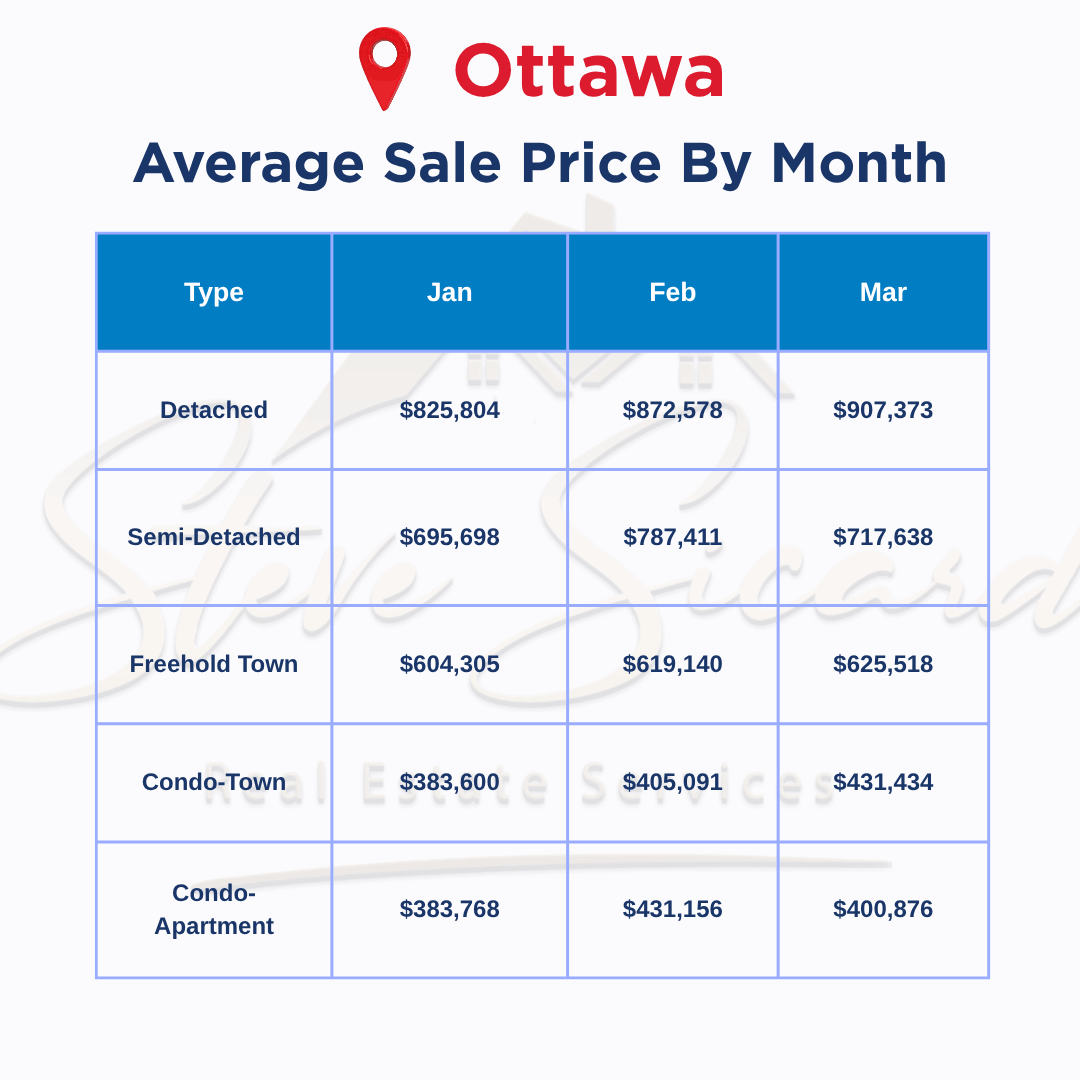
👉 I’ve added monthly sales data by property type to give you a clearer picture of how prices are actually moving right now.

Because here’s the truth:
📊 Year-over-year stats are helpful if you’re just curious about your home’s value…
💡 But month-to-month trends are far more useful if you’re thinking about buying or selling.

Let’s break it down 👇


📈 The Ottawa Market Is Gaining Momentum

After a slower winter, March showed clear signs of early spring activity.

👉 More buyers are stepping back into the market
👉 Sales activity is picking up
👉 Especially in the single-family home segment

While sales are still slightly below a “typical” March, the pace of improvement is accelerating.

💡 In simple terms:
The market is waking up—and gaining traction.


🏘️ Inventory Is Rising… But So Are Sales

One of the biggest stories right now:

📦 More homes are hitting the market
📈 But buyers are keeping up

This balance is important.

👉 It’s leading to a gradual tightening of the market
👉 Months of inventory are declining
👉 Homes are being absorbed more consistently across all property types

💡 This is what we call a healthy, balanced market


💰 Prices Are Starting to Firm Up

Here’s where it gets interesting for both buyers and sellers 👇

The MLS® Home Price Index has now recorded:
📈 Two consecutive months of price increases across most property types

That tells us:
👉 Home values are strengthening
👉 Buyer confidence is returning
👉 The spring market is taking shape

💡 We’re not seeing wild spikes—just steady, sustainable growth.


⚖️ A Balanced Market (With Momentum Building)

According to Ottawa Real Estate Board, Ottawa remains in balanced territory.

And that’s actually a good thing.

As Tami Eades, President of the Ottawa Real Estate Board (OREB) explains:

“What we’re seeing is a measured, steady return to activity. Inventory is up, sales are improving, and pricing is firming without overheating.”

👉 Translation:
No chaos. No crash. No frenzy.
Just a stable market with growing momentum.


🔮 What’s Coming Next?

Looking ahead, the outlook from Canadian Real Estate Association suggests:

📈 Demand is expected to strengthen
📉 Borrowing conditions may ease
🏡 Ottawa is already starting to align with this trend

On top of that, recent federal and provincial housing policies could:

👉 Increase activity
👉 Improve supply
👉 Support long-term stability


💡 What This Means for You

🏠 If You’re Buying:

  • More inventory = more choice

  • Prices are stabilizing (but starting to rise)

  • Acting sooner could give you an advantage


🏡 If You’re Selling:

  • Buyer demand is returning

  • Pricing is strengthening

  • Proper strategy is more important than ever


🤔 If You’re Just Watching:

  • Your home value is likely stabilizing or increasing

  • The market is not declining—it’s resetting and rebuilding momentum


📊 Why This Data Matters

This is exactly why I like to look at monthly trends, not just yearly comparisons.

Because real estate decisions aren’t made based on last year…
👉 They’re made based on what’s happening right now


📲 Thinking About Making a Move?

Whether you’re buying, selling, or just exploring your options…

💬 Let’s have a conversation. 
No pressure. Just clear insights to help you make the right decision for your situation. Contact me HERE

Read

🏡 The potential cost of sitting on the fence!

The Potential Cost of Waiting to Buy a Home

🤔 Are you waiting to buy?

Are you putting off buying your home, waiting and thinking that you will get a better deal at the end of the year, or some other time in the future?

There are a lot of things to consider, and it can feel overwhelming.


📉 You can’t time the market

If there is one thing that History has shown us, you can’t time the market. Yes, sometimes the stars align, but that is a rare occurrence.

When I bought my first home, my interest rate was 12.25%, and the rates went as high as 18% before they started coming back down.

We had the down payment and it did not stop us. We wanted to buy our first home, we were told the interest rate would go up.

We knew that rates would come down eventually and hopefully before we had to renew our mortgage.

👉 We all must make the decision that is right for us.


💡 If you’re ready financially…

If you are in a position financially right now to buy your home, then here are some points to consider.


📊 Ottawa Market Snapshot (2026)

It is now April 14, and the numbers are available for the first quarter or 2026. So, let’s look at some numbers.

The Ottawa real estate market is balanced and based on reports from sources such as CREA (Canadian Real Estate Association), and CMHC, Canada Mortgage and Housing Corporation, it will remain balanced throughout the year.

📈 The number of homes available is up 14.4 % compared to the first quarter of 2025.

📉 Although the number of homes sold for the first quarter are down 5.7% compared to the same period in 2025, and the average sale price is down 0.9% also for the same period, the home prices have risen, month to month in 2026.


📈 Average Sale Prices (Source: OREB)

🏠 Detached homes:

  • January $793,874

  • February $830,951

  • March $845,006

🏡 Townhomes:

  • January: $536,106

  • February: $539,639

  • March: 562,513

🏢 Condo/Apartments:

  • January: $388,307

  • February: $428,538

  • March: $401,656


📊 What does this mean?

You can see, with the exception of condo apartments, that the prices have risen month over month.

📈 That is an increase of around:

  • 6% for detached homes

  • 4.9% for townhomes

  • 3.43 % for condo apartments

I do not expect this rate of increase to continue based on past market cycles.


🔮 Market Predictions

Depending on which source you use, CMHC, CREA, or another, the predictions vary, from a 1% overall increase, to a 3.1% overall increase for the year.

It will differ for each property type based on home sales and number of available homes.


💸 Interest Rates Outlook

So far, the bank of Canada has held the key lending rate at 2.25%.

If we go by what most major economists are predicting, including CIBC, RBC, TD and National Bank, the overnight rate will likely remain steady at 2.25% for the entirety of 2026, though this is less certain now than before.

⚠️ Some outliers, like Scotiabank, predict a rise to 3.00% by the end of the year.

👉 That is not to say that lenders will not raise their rates.

For the sake of argument, Let’s say that the interest rates remain the same, so I won’t use this as a cost of waiting to buy.

📌 Please remember though, if the rates do go up, you will need to add it to the cost of sitting on the fence, waiting for a better purchase price.

👉 I will say, that I check in with different sources, and none of them are predicting a drop in home prices for Ottawa. We have already had that correction.


🧮 Let’s Run the Numbers

Let’s run some numbers. Since the predictions for home price increases range from 1% to 3.1%, let’s use 2%.

Also, since it is April, we will use the March sales numbers and a possession of July 1, leaving enough room to provide proper notice to landlords, to calculate the potential cost of sitting on the fence!


🏠 Detached:

Average sale Price March: $845,006. Projected December price: $861,906

👉 This is a difference of $16,900

The average rent for a 3-bedroom, 2-bath detached home is $3000. You can use your actual rent.

As mentioned earlier, we will start July 1, when you would take possession to calculate this cost and will include December.

👉 This number will be $18,000, with a total cost of $34,900


🏡 Townhouse:

Average sale Price March: $562,513. Projected December price: $573,763

👉 This is a difference of $11,250

The average rent for a 3-bedroom, 2-bath townhome is $2600. You can use your actual rent.

As mentioned earlier, we will start July 1, when you would take possession to calculate this cost and will include December.

👉 This number will be $15,600, with a total cost of $26,850


🏢 Apartment:

Average sale Price March: $401,656. Projected December price: $409,689

👉 This is a difference of $8,003

The average rent for a 2-bedroom, 1-bath apartment is $2100. You can use your actual rent.

As mentioned earlier, we will start July 1, when you would take possession to calculate this cost and will include December.

👉 This number will be $12,600, with a total cost of $20,603


⚖️ The Bottom Line

No one has a crystal ball. Prices and interest rates can change. No one can accurately predict the future. 

But based on current data and projections from sources like Canadian Real Estate Association, Canada Mortgage and Housing Corporation, and the Ottawa Real Estate Board:

👉 Waiting could cost you thousands of dollars

The real question isn’t:
“Is this the perfect time?”

It’s:
👉 “Am I ready—and does this move make sense for my life?”

Because when you’re ready…
That’s often the best time to act.


📲 Need Help Deciding?

If you’re unsure whether now is the right time to buy, let’s talk.

No pressure. Just real numbers, real data, and honest advice to help you make the right decision.

Read

Your Lender Is Counting On You Not Reading This

Let’s Take a Closer Look Before You Automatically Sign That Offer

Here's something most homeowners don't realize until it's too late: your mortgage renewal isn't a deadline. It's a planning window, and it opens months before any paperwork ever shows up at your door.


Your lender isn't going to tell you that, by the way.

Most renewal offers arrive close to maturity, dressed up to look simple and convenient. Sign here, keep your payment familiar, move on. No fuss, right? The problem is, the best options rarely show up at the last minute. By the time that envelope arrives, a lot of your most powerful choices are already off the table.


Starting early creates real leverage. It gives you time to compare structures, understand penalties, and actually decide whether staying put, switching lenders, or adjusting your mortgage makes sense for where your life is headed. Waiting until the final weeks usually means accepting whatever is easiest, not whatever is best. There is a difference.


And here's something we say all the time: rate matters, but structure matters just as much.

The term length affects how often you're back at the negotiating table. Prepayment options determine how aggressively you can chip away at your debt if your cash flow improves. Penalties can either protect you or trap you. Payment flexibility shapes how well your mortgage adapts as life keeps changing on you, because life always keeps changing.


In some cases, a slightly higher rate paired with better terms delivers more value than the lowest advertised rate with a pile of restrictions buried in the fine print. Flexibility creates options. Options create control. That's the long game.


Starting early also takes the pressure off. When decisions feel rushed, most homeowners default to familiarity or freeze up worrying about making a mistake. When decisions are planned, the trade-offs are clearer and confidence is higher. We see this all the time.


A strong renewal doesn't feel urgent or dramatic. It feels considered, intentional, and lined up with where you're actually headed next.


Have questions about your mortgage, or want us to compare what you're sitting on to what's currently available? We do free renewal reviews, and our advice could save you thousands.

Meet the team!

Reach out to us at 289-645-1568 or experts@laframboisemortgage.ca and let's review your options early so you go into your renewal with eyes wide open. There is no cost for our service & it could save you thousands.

Read

Reverse Mortgages:

Your Most Common Questions, Answered Honestly

If you're 55+ and considering a reverse mortgage, you probably have questions. Good. You should.

Reverse mortgages can be powerful financial tools for some people, but they're also complex products with real costs and long-term implications. We've sat across the table from hundreds of homeowners exploring this option, and these are the questions that come up every single time.

Let's get into it.


"Will I Lose My Home?"

Short answer: No.

You keep full ownership of your home with a reverse mortgage. Your name stays on the title, and you can live there as long as you want.

The reality is, you need to hold up your end of the deal:

  • Pay your property taxes on time

  • Keep home insurance current

  • Maintain the property in reasonable condition

Do those three things and you're good. The reverse mortgage only gets repaid when you choose to sell, move permanently, or when the home eventually passes to your estate.

Think of it like this: the lender has a loan secured against your property, but they don't own it and they can't force you out as long as you're meeting those basic obligations.


"What Happens to My Kids' Inheritance?"

Short answer: They inherit whatever equity is left.

Here's how it works. When the home is eventually sold (whether you sell it yourself or it's sold as part of your estate), the reverse mortgage gets paid off first. Your heirs get whatever's remaining.

A real example:

  • Your home sells for $600,000

  • Your reverse mortgage balance is $250,000

  • Your heirs receive $350,000

Your kids (or whoever inherits) have three options:

  1. Repay the loan and keep the house (they can refinance into their own mortgage if they want)

  2. Sell the home and keep the remaining equity

  3. Walk away (if the home is worth less than the loan, which is rare but possible)

Here's the part people worry about: Yes, your equity decreases over time as interest compounds on the reverse mortgage. If you take out $150,000 today, in 15 years you might owe $400,000+. That's $400,000 less inheritance.

We'll show you the projections with real numbers so your family knows exactly what to expect. No surprises.


"Can I Still Sell My Home If I Change My Mind?"

Short answer: Absolutely.

You can sell your home anytime you want. You're not locked in.

Here's what happens:

  • You list and sell your home like normal

  • The reverse mortgage gets paid off from the sale proceeds

  • You keep everything that's left over

  • You can use those funds to buy a new place, move into a condo, whatever you want

One thing to consider: Reverse mortgages have setup costs (appraisal, legal fees, arrangement costs). If you sell within the first couple of years, you've paid those costs for not much benefit. That's why we ask how long you plan to stay in the home before recommending this option.

But yes, you have complete freedom to sell whenever you choose.


"What If I Outlive My Home Equity?"

Short answer: You can't owe more than the home is worth.

This is huge and not enough people know about it.

Reverse mortgages in Canada come with a "no negative equity guarantee." Even if your loan balance grows larger than your home's value (which can happen if you live there for decades and home values don't increase), you or your estate will never owe more than what the home sells for.

Example scenario:

  • Your reverse mortgage balance grows to $500,000

  • Your home only sells for $425,000

  • You (or your estate) pay $425,000 and the lender absorbs the $75,000 difference

The lender takes that risk, not you. That's part of what you're paying for with the higher interest rates on reverse mortgages.


"How Much Can I Actually Borrow?"

Short answer: It depends on your age, home value, and location.

The younger you are, the less you can borrow (because the loan has more time to grow). The older you are, the more you can access.

Rough guidelines:

  • Age 55-60: Around 20-25% of your home's value

  • Age 65-70: Around 30-40% of your home's value

  • Age 75+: Around 50-55% of your home's value

Example: If you're 65 with a $500,000 home, you might be able to access $150,000 to $200,000.

Your home's location matters too. Homes in major markets (Toronto, Vancouver, etc.) often qualify for slightly higher amounts than homes in smaller communities.

Important: Just because you CAN borrow the maximum doesn't mean you SHOULD. The more you take, the faster your equity disappears. We'll help you figure out the minimum you actually need to accomplish your goals.


"What Are the Real Costs?"

Short answer: Higher than a regular mortgage, but you're paying for flexibility.

Let's be straight with you. Reverse mortgages are expensive. You're paying for the privilege of:

  • No monthly payments

  • Guaranteed ability to stay in your home

  • No income qualification requirements

  • The lender's risk that you might outlive your equity

Setup costs:

  • Appraisal fee: $300-500

  • Legal fees: $1,000-1,500

  • Lender arrangement/setup fees: Varies by lender

  • These typically get added to your loan (you don't pay out of pocket)

Ongoing costs:

  • Interest rates: Currently around 6-8% (higher than traditional mortgages at 4-6%)

  • The interest compounds because you're not making payments

  • Your loan balance grows every year

What this means in real dollars:

Borrow $150,000 at 7% interest:

  • After 5 years: You owe approximately $210,000

  • After 10 years: You owe approximately $295,000

  • After 15 years: You owe approximately $413,000

The math can be scary. That's why we show you the projections BEFORE you sign anything, not after.


"Do I Have to Take All the Money at Once?"

Short answer: Nope, you have options.

Most reverse mortgage products let you structure the payout however works best for you:

1. Lump sum: Get all the money upfront (common for paying off existing debts or major expenses)

2. Monthly payments: Receive a set amount each month to supplement income

3. Line of credit: Access funds as needed (only pay interest on what you actually use)

4. Combination: Part lump sum, part monthly, part line of credit

The line of credit option can be smart because you're only paying interest on money you've actually drawn, not the total available amount. Less money borrowed equals slower equity erosion.


"What If My Spouse Is Younger Than 55?"

Short answer: It gets complicated, but it's doable.

Both spouses need to be at least 55 to qualify for a reverse mortgage. If one of you is younger, you have a couple of options:

Option 1: Wait until the younger spouse turns 55

Option 2: Put the home solely in the older spouse's name

  • This can work but has risks

  • If something happens to the older spouse, the younger one needs to either repay the loan or sell

  • Not ideal for most couples

Option 3: Look at alternative products

  • Some lenders offer similar products with different age requirements

  • Usually come with different terms and costs

If there's a significant age gap, we need to talk through the implications carefully. The last thing anyone wants is the surviving spouse facing a financial crisis.


"Can I Get a Reverse Mortgage If I Still Have a Regular Mortgage?"

Short answer: Yes, but the existing mortgage gets paid off first.

Here's how it works:

Let's say you're 68, your home is worth $600,000, and you still owe $150,000 on your regular mortgage.

If you qualify for a $250,000 reverse mortgage:

  • $150,000 goes to pay off your existing mortgage

  • You receive the remaining $100,000

The benefit? You've eliminated your monthly mortgage payment AND accessed additional cash. For some retirees struggling with fixed income, this can be a huge relief.

The downside? You're now in a more expensive mortgage product, and your equity is decreasing faster than it would have with the original mortgage.

We'll run both scenarios to show you the long-term impact.


"Is This Just a Scam for Desperate Seniors?"

Short answer: No, but we understand the skepticism.

Reverse mortgages have gotten bad press over the years, sometimes deservedly. In the past, some products had predatory terms, aggressive marketing, and weren't properly explained to vulnerable seniors.

The reality today:

  • Reverse mortgages are regulated financial products in Canada

  • Lenders must follow strict disclosure rules

  • You're required to get independent legal advice before signing

  • Modern products include consumer protections (like that no negative equity guarantee)

That said, they're still not right for everyone. They're expensive, they reduce your equity, and they can impact your family's inheritance.

Here's our take: A reverse mortgage is a tool. Like any tool, it can be used well or used poorly. Our job is to help you figure out if it's the RIGHT tool for YOUR situation, show you what it actually costs, and make sure you understand what you're getting into.

If we think you're making a mistake, we'll tell you. We're building a business on honesty, not just closing deals.


Got More Questions?

You deserve clear, honest answers. Not a sales pitch.

Book a free consultation and we'll:

  • Answer all your questions with real numbers

  • Show you what you actually qualify for

  • Compare reverse mortgages against every alternative available

  • Give you straight talk about whether this makes sense for YOU

Call us: 289-645-1568

Email us: experts@laframboisemortgage.ca

Meet the team

There's zero shame in exploring your options. Never be too shy to call. We've truly seen it all.

Laframboise Mortgage: Your mortgage... rethought!

Read

🏡 Aging in Place: Your Options, Costs & What to Consider

☕ Let’s Sit Down and Talk About This…

If you or someone you love is starting to think about the future…

👉 “Can I stay in my home as I age?”

You’re asking one of the most important questions there is.

And honestly?

👉 Aging in place should always be the first option to consider.


❤️ Why Aging in Place Matters

There’s something powerful about staying in a place that feels like home.

Your routines
Your neighbours
Your community
Your favourite stores and services

It’s all familiar—and that matters more than most people realize.

👉 Familiarity supports both emotional and physical well-being

That’s one of the reasons governments are investing more into:

  • In-home care services

  • Community support programs

  • Accessibility resources

Because when it works…

👉 Aging in place can lead to a better quality of life


⚠️ But Here’s the Honest Truth…

Aging in place isn’t always possible.

And that’s okay.

The goal isn’t to force staying in your home…

👉 It’s to find what works best for you—now and in the future.


🧠 Step 1: Assess Your Current Home

This is where I always suggest starting—with a simple, honest conversation.

Ask yourself (and your family):

  • Will this home still work if mobility becomes an issue?

  • Are there stairs, narrow hallways, or difficult layouts?

  • Can key areas (like bathrooms) be adapted safely?


🔧 Can Your Home Be Modified Safely?

Many homes can be adapted—but it has to be done properly.

For example:

👉 Grab bars in a bathroom

Sounds simple, right?

But here’s what I’ve seen happen:

A handyman installs them using hollow wall anchors…
and when weight is applied?

👉 They fail.

That’s dangerous.


💡 The Right Approach:

  • Work with qualified professionals

  • Ensure proper structural installation

  • Plan modifications based on future needs—not just current ones


💰 What About the Cost?

This is a big part of the decision.

You’ll want to look at:

  • Your available savings

  • Cost of renovations

  • Long-term affordability

  • Available grants or programs

👉 There are options available to help with costs

But the key is:

👉 Speak with someone who will walk you through all of them clearly


🏡 Aging in Place Doesn’t Always Mean Staying Put

This is something many people don’t consider.

👉 You can still “age in place”… just in a different home


💡 What That Might Look Like:

  • A bungalow instead of a two-storey

  • A smaller home with less maintenance

  • A condo with no snow removal or lawn care

  • A home with better accessibility


⚠️ Why This Matters

Your current home might have:

  • A large yard that’s hard to maintain

  • Rooms you don’t use (but still pay to heat and clean)

  • Ongoing upkeep that’s becoming stressful

👉 That adds up—physically, financially, and emotionally


✨ The Goal?

👉 A home that makes daily life easier—not harder


🌿 Lifestyle Still Matters

Let’s say you love gardening…

You don’t need a big property to keep that joy.

👉 A smaller yard or manageable outdoor space might be perfect

It’s about:

  • Keeping what matters

  • Letting go of what doesn’t


🏢 When a Seniors’ Community Might Be the Right Move

For some people, the best option is moving into a senior living community.

And if you haven’t visited one recently…

👉 It’s worth taking another look


🏡 What Many People Don’t Realize:

Independent living suites today often feel like:

  • Condo-style living

  • Private, comfortable spaces

  • Freedom to come and go

But with added benefits:

✔ No home maintenance
✔ No worries when traveling
✔ Social activities and events
✔ Built-in community and support


👉 For many, it’s not a step back…
it’s a step into a more supported and enjoyable lifestyle


🤝 The Most Important Thing to Remember

You have options.

👉 Staying in your home
👉 Modifying your home
👉 Moving to a better-suited home
👉 Exploring a senior community

There is no one-size-fits-all answer.


💬 Final Thought (This Matters Most)

This isn’t about making a quick decision.

👉 It’s about making the right decision

For you
For your lifestyle
For your future


📩 If You Want Help Navigating This…

If you’re starting to think about aging in place—or exploring other options—

👉 I’m here to help

Whether it’s:

  • Connecting you with trusted professionals

  • Walking through your home together

  • Helping you explore alternatives

No pressure. No timeline.

Just a conversation. Reach out to me HERE

Read

🏡 Rightsizing Your Home: Why Downsizing Isn’t Just for Seniors

☕ Let’s Talk About Something Most People Don’t Realize…

When you hear the word downsizing, what comes to mind?

For most people, it’s:
👉 retirees
👉 empty nesters
👉 seniors moving into smaller spaces

But here’s the truth…

👉 Downsizing isn’t just for Boomers and Seniors.

In fact, I like to call it something a little different:

💡 Rightsizing

Because this isn’t about going smaller…
👉 it’s about finding the right fit for your life.


🧠 What Is Rightsizing (Really)?

Let’s imagine we’re sitting at your kitchen table for a minute.

You look around your home and think:

  • “We don’t use half these rooms anymore…”

  • “This place is a lot to keep up with…”

  • “Why does this feel more stressful than it used to?”

That’s not random.

👉 That’s your home no longer matching your lifestyle.


🏡 Rightsizing Doesn’t Mean Giving Up What You Love

This is one of the biggest misconceptions I hear:

👉 “I don’t want to feel cramped…”
👉 “I still want a big kitchen…”

And you absolutely can.

Rightsizing doesn’t necessarily mean smaller rooms—
it means less overall square footage.

You can still have:
✔ A spacious kitchen
✔ A comfortable living area
✔ The features that matter most to you

👉 The difference is this:

You’re focusing on the rooms you actually use
…and letting go of the ones you don’t.

So instead of:

  • Extra bedrooms sitting empty

  • Formal spaces rarely used

  • Unused square footage to maintain

You have:
👉 A home designed around your real life


⚠️ Signs Your Home Might Not Be Working for You Anymore

This isn’t always obvious—but it shows up in small ways:

🔑 Common Signs:

  • You’re only using part of your home

  • Maintenance feels overwhelming

  • Cleaning takes more time than you want to give

  • Your space feels cluttered or inefficient

  • Your lifestyle has changed (kids moved out, working from home, etc.)

  • You feel more stressed in your home than relaxed

And here’s the big one…

👉 Your home feels like work instead of comfort


❤️ Why This Isn’t Just a “Space” Decision

This is where people get stuck.

They think:
👉 “But we love this home…”

And that’s completely valid.

Because a home is more than walls and a roof:

  • It’s memories

  • It’s milestones

  • It’s your story

But here’s the shift:

👉 You’re not leaving your life behind—you’re making room for your next chapter


✨ What Happens When You Rightsize?

This is the part most people don’t expect.

When the home fits your life again, everything feels easier.

💡 The Benefits:

✔ Less maintenance
✔ Lower monthly costs
✔ More usable space (not just more space)
✔ Easier day-to-day living
✔ More time for what matters

And maybe most importantly…

👉 More peace of mind


👨‍👩‍👧 Rightsizing Is for Every Stage of Life

This applies to:

  • Growing families needing better function

  • Couples with changing lifestyles

  • Empty nesters

  • Seniors

  • Anyone feeling “out of sync” with their home

Because life changes…

👉 and your home should evolve with it


🧭 How to Start (Without Overwhelm)

The biggest mistake people make?

👉 Trying to figure everything out at once

Instead, keep it simple:

✔ Step 1: Ask Yourself

  • What do I actually use in my home?

  • What feels like too much?

  • What would make life easier?


✔ Step 2: Start Small

  • One room at a time

  • One decision at a time


✔ Step 3: Explore Options

  • Condo

  • Bungalow

  • Smaller footprint (not smaller lifestyle 😉)

  • Different location

No pressure—just possibilities.


💬 Final Thoughts (This Is the Important Part)

Rightsizing isn’t about giving something up.

👉 It’s about creating a home that supports your life today—not the life you had 10 or 20 years ago.

And if your current home is causing stress…

👉 there’s a good chance a better fit exists.


🤝 If You’re Starting to Think About This…

If you’re reading this and thinking:

👉 “This sounds like us…”

You don’t need to make a decision today.

You just need to start the conversation.

📩 If you want to talk through your options—no pressure, no timelines—
I’m here to help you figure out what makes the most sense for you and your family.

Contact me HERE to book our conversation. 

Read
Categories:   aging in place | Aging in place Orleans | aging in place Ottawa | aging parents | Average home price in Ottawa | benefits of downsizing at any age | benefits of downsizing in retirement | buying a home ottawa | Can I negotiate my mortgage renewal rate | checklist | CHIP Reverse Mortgage | CHIP Reverse Mortgages | cost of renovating | cost of renting vs buying | downsize | downsizing | downsizing and selling a home in Ottawa | downsizing for families not just seniors | downsizing home seniors | downsizing in Ottawa | downsizing Ottawa Orléans | downsizing seniors Ottawa | downsizing timeline | empty nesters | enior real estate specialist Ottawa | essential spring home maintenance tasks | First time buyers | first time home buyer | first time home buyer vs renting | helping elderly parents sell their house | helping parents sell their home | helping seniors downsize | home buyers | home buying | home buying costs | home buying mistakes Canada | home buying mistakes to avoid | home buying tips | home checklist | home improvement or sell | home inspection | home inspections | home maintenance | home maintenance tips for spring | home maintenance tips to avoid costly repairs | home owners | home ownership | home prices ottawa | home renovation vs moving | home renovations | home repairs | home selling | homeowners | housing market | housing market Ottawa | how to increase home value before selling | how to know when to downsize your home | how to prepare your home for sale | how to prepare your home for spring | How to save money on mortgage renewal | how to simplify your home and lifestyle | how winter affects home buying decisions | Is it a good time to buy a home in Ottawa? | Is it a good time to sell a home in Ottawa? | is now a good time to buy a home | Is now a good time to buy a home in Ottawa | lifestyle | maintenance | Market Update | mistakes after mortgage approval home buyers | Mooneys Bay - Carleton Heights and Area Real Estate | mortgage | mortgage approval | mortgage fraud | mortgage renewal | mortgage renewal mistakes to avoid | mortgage renewal mistakes to avoid Canada | mortgage renewal strategies homeowners | mortgage renewal tips | mortgage renewals | mortgagefraud Ontario | mortgages | Moving | moving to a new home | Ontario real estate fraud | ontario seniors | Orleans - Convent Glen and Area Real Estate | Orleans - Cumberland and Area Real Estate | Orleans Real Estate Agent | Orleans Realtor | ost of waiting to buy a home | ost of waiting to buy a home Ottawa | Ottawa home prices | Ottawa home prices June 2026 | Ottawa housing market | Ottawa housing market outlook | Ottawa housing market report | ottawa housing market trends | ottawa real estate | Ottawa Real Estate Agent | Ottawa real estate blog | Ottawa Real Estate Market June 2026 | ottawa real estate market update | Ottawa real estate news | ottawa real estate outlook 2026 | Ottawa Realtor | Ottawa seniors | Ottawa single family home prices | planning for retirement housing | planning your next chapter | post winter home maintenance checklist | preparing for retirement | preventative home maintenance tips | protecting home equity in Ontario | Real Estate | real estate agent | Real Estate Agent in Orleans | Real Estate Agent in Ottawa | real estate market update ottawa canada | realtor | Realtor in Orleans | Realtor in Ottawa | renovate or move | renting vs buying Ottawa pros and cons | retirees | retirement | retirement downsizing tips for homeowners | retirement home planning | retirement lifestyle | Reverse mortgage | reverse mortgage Canada | reverse mortgage for seniors 55 plus Canada | reverse mortgage pros and cons | reverse mortgage pros and cons for seniors | reverse mortgage questions answered | Reverse mortgages | rightsize | rightsizing | selling a home ottawa | selling a parent’s home in Ontario | senior living options | senior living options Ottawa | seniors | seniors downsizing | seniors in Ottawa | seniors ontario | seniors real estate specialist | Seniors Real Estate Specialist Orleans | Seniors Real Estate Specialist Ottawa | Seniors Real Estate Specialist® | seniors targeted by mortgage fraud | should I buy a house now or wait | should I renovate my house | should I rent or buy a home | should seniors have title insurance in Ontario | signs it is time to downsize your house | signs your home no longer fits your life | simple home maintenance tasks that make a difference | small home maintenance tasks that save money | spring | spring home maintenance | spring home maintenance checklist | spring maintenance checklist for homeowners | SRES | SRES® | staging | steps before buying a home | title fraud | title fraud Ontario | title fraud Ottawa | title insurance | title insurance for homeowners | title insurance for seniors | Title insurance Ontario | title insurance ottawa | title insursance | what do home inspectors check | what does a home inspector look for | what not to do after mortgage approval | what to look for when buying a house in winter Canada | when should I downsize | When should I start my mortgage renewal | when to downsize | when to downsize your home | when to downsize your home in retirement | why credit matters before closing day | why home inspections are important | winter home buying tips Ottawa Ontario
This website may only be used by consumers that have a bona fide interest in the purchase, sale, or lease of real estate of the type being offered via the website. The data relating to real estate on this website comes in part from the MLS® Reciprocity program of the PropTx MLS®. The data is deemed reliable but is not guaranteed to be accurate.